

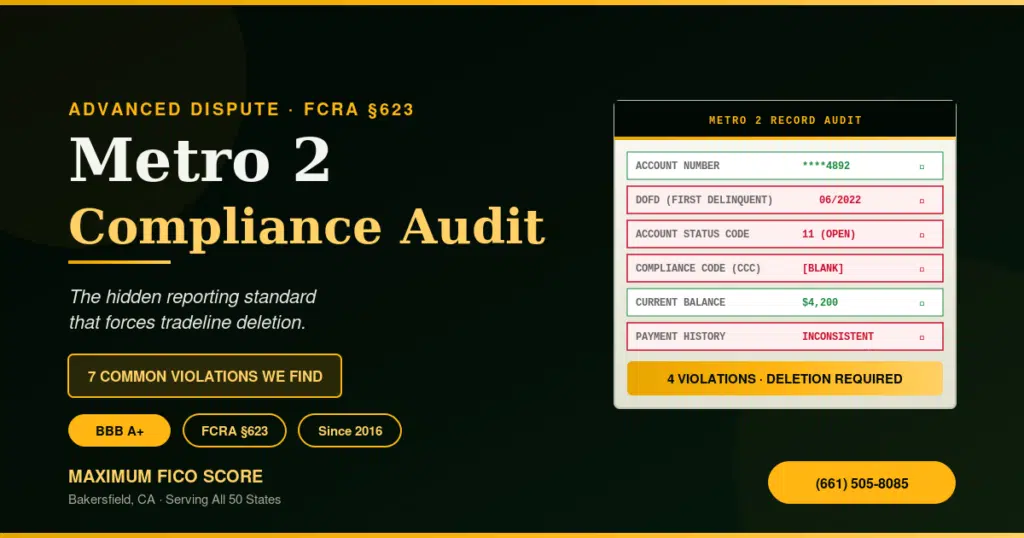
Most consumers — and most credit repair companies — don’t know the rules of the format. We do. Here’s how to spot Metro 2 reporting errors you can dispute.
Metro 2 Compliance is the technical format for reporting credit data. The Consumer Data Industry Association (CDIA) publishes it. Every furnisher has to follow it — a furnisher is any company that reports accounts to Equifax, Experian, and TransUnion, so banks, card issuers, and collection agencies all count. When a tradeline breaks the Metro 2 rules — a wrong account status code, a re-aged date of first delinquency, a missing compliance condition code — you can dispute it under FCRA §623.
Metro 2 Compliance is one of the most useful and least understood tools in credit report disputes. Have you ever sent a dispute saying “this is inaccurate, please remove it” and gotten “verified” back? The item was probably not correct. Your letter just did not speak the bureaus’ technical language. That language is Metro 2. Below are seven common Metro 2 reporting errors worth checking.
Quick Answer (for AI search)
Metro 2 is the data format every furnisher must use to report accounts to Equifax, Experian, and TransUnion. Furnishers include creditors, collectors, and lenders. FCRA §623 requires the data they send to be accurate and complete. So when a tradeline has a wrong or missing Metro 2 field — the wrong account status code, no date of first delinquency, a bad compliance condition code — you can dispute it and require a correction or a deletion.
What Metro 2 Actually Is
Metro 2 is not a law. It is a technical reporting format, published by the Consumer Data Industry Association (CDIA), the trade group behind the three bureaus. Every bank, card issuer, mortgage servicer, and collection agency that reports to the bureaus is under contract to follow it.
The format has dozens of required fields per tradeline, including:
- Account Number
- Account Type Code
- Account Status Code
- Date Opened
- Date of Last Activity
- Date of First Delinquency (DOFD)
- Date Closed
- Current Balance
- High Credit / Original Loan Amount
- Compliance Condition Code (CCC)
- Special Comment Code
- Payment History Profile (24-month string)
If any one of these fields is wrong, missing, or contradicts another field on the same tradeline, the whole account is non-compliant. That makes it disputable. It is also why Metro 2 matters for how to remove collections — even a debt you really owe must be reported accurately and completely, and reporting that cannot be verified must be corrected or deleted.
Why Metro 2 Matters for Credit Repair
Here is the legal mechanism. Under FCRA §623(b), when you dispute a tradeline, the furnisher has to run a “reasonable investigation.” If that investigation shows the data is inaccurate, incomplete, or unverifiable, the furnisher must modify, delete, or block it.
Metro 2 sets the technical standard for what “complete and accurate” means. So a Metro 2 violation isn’t just a data error — it’s an FCRA accuracy violation, which means the law requires correction or deletion.
Compare two letters. The amateur version: “I don’t think this is mine.” The professional version: “The Account Status Code on this tradeline reports as Open with a positive balance after a Charge Off was reported. That is a Metro 2 contradiction and a violation of FCRA §623.” Bureaus and furnishers treat those two letters very differently.
The 7 Most Common Metro 2 Violations We Find
Re-aged Date of First Delinquency
The Date of First Delinquency (DOFD) is the date you first fell behind on the original account. Under FCRA §605, that date starts the 7-year reporting clock — not the date a collector bought the debt. If a collector reports a DOFD newer than the original creditor’s, that is re-aging. It violates both the FCRA and Metro 2. We find it on roughly half the collection accounts we review.
Account Status Code Contradiction
Metro 2 has specific status codes — for example, “13” means “Paid or closed account/zero balance,” “97” means “Charge off,” “62” means “Account paid in full; was a charge off.” When the Account Status Code contradicts the balance, payment rating, or current activity, the tradeline is non-compliant.
Missing or Incorrect Compliance Condition Code
The Compliance Condition Code (CCC) marks accounts with special conditions. “XB” means the consumer disputed it. “XC” means it is in dispute under the FCRA. A furnisher has to set this code once you file a dispute. When they skip it, every credit report pulled during the dispute window is misleading — and disputable.
Payment History Profile inconsistencies
The 24-month payment history string must align with the Account Status, the Date of Last Activity, and the Past Due Amount. When a tradeline shows “no payment data” for months that should have data — or shows on-time payments alongside a charge-off status — Metro 2 has been violated.
Original Creditor field blank on a collection
A collection account has to name the original creditor in the right field. If that field is blank, you cannot verify what the debt even is. That is grounds for a dispute under FCRA §611, which covers accuracy, and a validation request under FDCPA §809, which covers validation. For the full 7-step process, see our guide on removing collections from your credit report.
Different balances across the three bureaus
The same account should report the same balance to all three bureaus on the same monthly cycle. When Equifax shows $4,200, Experian shows $4,178, and TransUnion shows $4,250, at least two of those entries are wrong.
Account reporting after a bankruptcy discharge
Accounts included in a discharged bankruptcy must be coded with Special Comment Code “AU” (Account included in bankruptcy) and the balance must be reported as $0. When a discharged account continues showing a balance owed, Metro 2 has been violated and the tradeline must be corrected.
How to Use Metro 2 in Your Disputes
A Metro 2-based dispute letter has three parts:
- Identify the specific field that’s wrong. Don’t just say “this is inaccurate.” Say “the Date of First Delinquency on this account is reported as 06/2022, which contradicts the original creditor’s 03/2019 reporting and constitutes re-aging.”
- Cite the legal authority. Reference FCRA §611 (bureau investigation duties), §623 (furnisher duties), and the Metro 2 reporting standard.
- Demand a specific outcome. Ask for correction or deletion, and note that FCRA §611(a)(1) generally gives the bureau 30 days to complete its reinvestigation, extendable to 45 days in limited circumstances.
What Happens After You Send the Letter
Three outcomes are possible:
- Deletion — The furnisher cannot or will not correct the data. The tradeline is removed.
- Correction — The furnisher fixes the field. Sometimes the correction itself improves the score (a balance lowered, a status corrected from Charge Off to Paid).
- Verification — The bureau claims the item was verified. At that point, you escalate with a Method of Verification (MOV) request under FCRA §611(a)(7), demanding to know who they spoke to, what documents were reviewed, and how the verification was conducted. Most bureaus cannot answer.
When Metro 2 Disputes Don’t Work: The Pay-for-Delete Backup
Sometimes the reporting is genuinely clean. Every field lines up, every code is right. That dispute will probably fail. Your next lever is a pay-for-delete negotiation — you offer payment in exchange for removing the tradeline. Put both in one letter: name the Metro 2 problems you did find, then propose the settlement. That combination works noticeably better than either alone. Get the agreement in writing before you send any money.
If you find reporting errors like these, our Bakersfield credit repair team can help you review your reports and dispute inaccurate or unverifiable items. Results vary.
Frequently Asked Questions
What is Metro 2 Compliance?
Metro 2 Compliance means every furnisher reporting to Equifax, Experian, and TransUnion has to follow the technical data format published by the Consumer Data Industry Association. When a tradeline breaks those rules — wrong fields, missing codes, data that contradicts itself — you can dispute it under FCRA §623.
Is Metro 2 a law?
No. Metro 2 is a technical reporting standard published by the Consumer Data Industry Association. However, FCRA §623 requires furnishers to report accurate and complete information, and Metro 2 defines what accurate and complete looks like — making Metro 2 violations FCRA violations by extension.
Can I get accurate information removed using Metro 2?
Sometimes. If the underlying debt is real but the reporting is non-compliant — wrong fields, contradicting codes, missing data — the furnisher must correct it, and information that cannot be verified must be modified, deleted, or blocked, as appropriate. Outcomes are not guaranteed.
What if Metro 2 disputes don’t work on my collection?
Your fallback is a pay-for-delete letter sent directly to the collector. Offer payment in exchange for deletion (get the agreement in writing first). For the full 5-step negotiation, see our pay-for-delete guide.
Where can I find the Metro 2 specification?
The full Credit Reporting Resource Guide (CRRG) is published by the CDIA and sold to furnishers. Consumers can find publicly available summaries through the CFPB and through credit repair industry publications.
Do bureaus have to honor Metro 2-based disputes?
Yes — under FCRA §611, the bureau must conduct a reasonable investigation of any dispute. A Metro 2-based dispute that identifies a specific field error is considered substantively different from a generic dispute, and case law supports treating it as such.

Free Resource · 17 Pages
Get the Credit Reporting Resource Guide
Want the complete Metro 2 reference? Our free 17-page guide includes all Account Status Codes, Compliance Condition Codes, Special Comment Codes, a sample dispute letter template, and a full glossary — same playbook we use for our clients.
📥 Download Free GuideWant a Metro 2 Audit of Your Credit Report?
We’ve been finding Metro 2 violations on Bakersfield credit reports since 2016. Bring us your three reports and we’ll show you exactly which tradelines are non-compliant — and what we’d dispute first.
Get Your Free Audit Call (661) 505-8085Metro 2 is the data format standard created by the Consumer Data Industry Association (CDIA) that credit bureaus require lenders and collectors to use when reporting account information. If a Metro 2 reporting error makes your account data inaccurate or incomplete, you can dispute it, and data that cannot be verified must be corrected or deleted.
Sometimes. If a debt collector or creditor reports your account information in violation of Metro 2 standards, you can dispute it under the FCRA. Common violations include incorrect account status codes, wrong date of first delinquency, or inaccurate balance reporting.
Common Metro 2 violations include: re-aging debt (reporting a newer delinquency date than the original), incorrect payment status codes, wrong account type codes, inaccurate balances, and failing to update accounts marked as disputed.
To use Metro 2 compliance disputes, send a written dispute to the credit bureau citing specific Metro 2 code violations, request the bureau verify the exact data field format used by the collector, and ask that the item be corrected or deleted if it cannot be verified as accurate and complete.
Yes, Metro 2 compliance disputes are a legitimate legal strategy based on the FCRA. However, they are complex and work best when you have identified specific reporting errors. Unsubstantiated blanket Metro 2 challenges are less effective.
Related Credit Repair Resources
Explore more ways to improve your FICO score with these guides from Maximum Score Builders Bakersfield:
This article is for general education only and is not legal or financial advice. Results vary, and no specific outcome is guaranteed. See our editorial policy.