

Last updated October 12, 2026
Learning path: Credit Building
The AZEO Method: How to Optimize Credit Utilization and Maximize Your FICO® Score
Maximum Score Builders • Credit & FICO Education • Bakersfield, CA
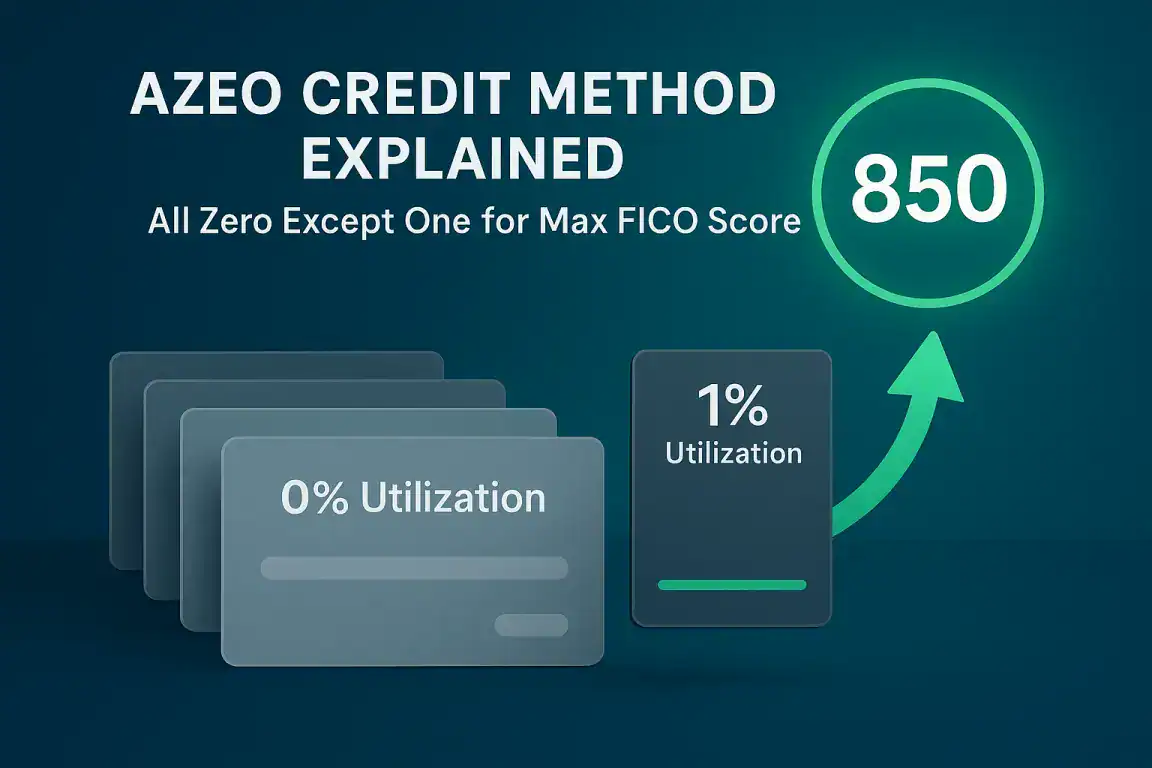
AZEO stands for All Zero Except One. You pay every revolving credit card down to a $0 reported balance except one, which you let report a small balance — typically 1–9% of that card’s limit. What matters is the balance on each card’s statement closing date, not the day you pay.
If you’ve been researching how to raise your score quickly before a mortgage, auto loan, or refinance, you’ve probably run into four letters: AZEO. It stands for All Zero Except One, and it’s one of the most effective — and most misunderstood — ways to optimize the credit utilization portion of your FICO score. This guide explains exactly what it is, why it works, and how to execute it safely, step by step.
In this guide
What the AZEO Method Actually Is
AZEO — All Zero Except One — is a credit-card balance strategy. The idea is simple: you pay down every revolving credit card to a $0 reported balance except for one card, which you allow to report a small balance (typically 1–9% of that card’s limit). When the credit bureaus take their monthly snapshot, your profile shows almost no debt — but still shows active, healthy card usage.
Here’s the key insight most people miss: your FICO score doesn’t look at what you owe today. It looks at the balance each card reports on its statement closing date. AZEO is about controlling that reported number — the snapshot — rather than how you spend day to day.
Why AZEO Works: Utilization and Your Credit Score
Credit utilization — the percentage of your available revolving credit you’re using — is one of the most powerful factors in the FICO scoring model, and a key part of the Amounts Owed category, which makes up roughly 30% of the traditional FICO breakdown. That category is second only to payment history, and unlike payment history, it can change dramatically from one month to the next. That makes it the fastest lever most consumers can pull.
FICO actually measures utilization two ways, and AZEO is designed to optimize both at the same time:
- Aggregate (overall) utilization — your total reported balances across all cards divided by your total credit limits. AZEO drives this close to zero.
- Per-card (individual) utilization — the balance on each single card versus that card’s own limit. AZEO keeps every card at 0% except one card sitting in the low single digits.
The commonly cited benchmark is to stay under 30% utilization, but that’s a floor, not a goal. FICO does not publish a single “best” utilization percentage, and no range guarantees a particular score. AZEO is simply a structured way to keep reported balances low on the day your balances report; how your score responds depends on the scoring model and your overall credit profile.
The percentages that matter
- Under 30%: acceptable — the minimum most lenders want to see.
- Under 10%: lower — generally viewed more favorably than higher utilization, though results vary.
- 1–9% on one card, 0% on all others: the usual AZEO setup — keeps both overall and per-card reported utilization low.
- 0% on everything: good, but often slightly less effective than leaving one small balance.
How to Execute AZEO Safely, Step by Step
The most important thing to understand is timing. Because your score reacts to reported balances, you have to pay your cards down before each card’s statement closing date — not the due date. The closing date is when the balance is captured and sent to Experian, Equifax, and TransUnion. Here’s the process we walk Bakersfield credit repair clients through:
- Find each card’s statement closing date. It’s on your statement or in your online account — and it’s usually about three weeks before your payment due date. Write down the closing date for every card.
- Choose your “one” card. Pick a single card — ideally one of your older accounts or one with a mid-range limit — to carry the small reported balance.
- Pay the other cards to zero before their closing dates. A few days before each card closes, pay the balance down to $0 so it reports zero. Leaving it a day or two early gives the payment time to post.
- Leave a small balance on your one card. Aim for a reported balance of roughly 1–9% of that card’s limit (for a $1,000 limit, that’s $10–$90). Don’t pay it to zero before it closes — let the small balance report.
- Pay the statement in full by the due date. After the balance reports, pay that remaining balance off by the due date so you never carry debt or pay interest. AZEO is a reporting strategy, not a reason to revolve a balance.
- Repeat each cycle before you apply. Utilization has no memory — it resets every month. Run AZEO for the statement cycle (or two) right before you apply for a mortgage, auto loan, or new credit, when the optimized snapshot matters most.
Common AZEO Mistakes to Avoid
AZEO is safe and legitimate — it’s just careful timing of your own money. But small errors undo the benefit. Watch for these:
- Paying by the due date instead of the closing date. This is the #1 mistake. Pay by the due date and your high balance has usually already reported. Always work to the closing date.
- Closing old cards to “simplify.” Closing a card removes its limit from your total available credit, which raises your utilization and can shorten your average account age. Keep old accounts open.
- Letting all cards report $0. Leave one small balance so your profile still shows active revolving use.
- Opening a new card right before applying. The hard inquiry and lower average account age can offset your utilization gains at the worst possible time.
- Carrying the balance and paying interest. AZEO never requires you to revolve debt. Let the small balance report, then pay it in full.
- Forgetting business or charge cards. Know which of your cards report to the personal bureaus and which don’t, so you optimize the right accounts.
What AZEO Can’t Fix — and What Can
Here’s the honest part. AZEO is powerful for one specific thing: optimizing your current utilization so your score reflects your best possible snapshot. But it can’t touch the other things that may be quietly holding your score down — a collection that isn’t yours, a late payment reported in error, a charge-off with the wrong balance, or a duplicate account inflating your debt. Utilization tricks can’t remove inaccurate history; only a proper review and dispute under the Fair Credit Reporting Act (FCRA) can address those.
That’s the difference between optimizing a score and correcting a credit report. AZEO handles the first. If you suspect inaccurate, outdated, or unverifiable items are dragging you down, the next step is a professional audit of all three of your reports. As a credit repair Bakersfield team, that’s exactly what we do — and your first look is free.
Claim Your Free Credit Audit
See exactly what’s helping and hurting your score across Experian, Equifax, and TransUnion. No obligation, no pressure — just an honest, FCRA-compliant review from our Bakersfield credit repair team.
Master your utilization with AZEO, correct anything inaccurate with a real audit, and you’re working both levers at once — the fastest, most durable path to a stronger FICO score.
This article is educational only and does not constitute legal or financial advice. AZEO is a personal credit-management strategy; results vary by individual credit profile, and no specific score increase is guaranteed. Maximum Score Builders is a credit services organization following the consumer protections in the Fair Credit Reporting Act (FCRA), the Fair Debt Collection Practices Act (FDCPA), and the Credit Repair Organizations Act (CROA). Consumers have the right to dispute inaccurate information directly with the credit reporting agencies free of charge. © 2016–2026 Maximum Score Builders, Bakersfield, CA.
Related Guides
- How Often Is a Credit Score Updated?
- Credit Education and Repair Resources
- Free Credit and Debt Calculators
- Free Credit Education Hub
- Credit utilization: how the ratio actually works
- Rapid rescore: when AZEO is not fast enough
- The fastest way to boost credit before a mortgage
- Credit repair for homebuyers in Bakersfield
- FICO Score 8 vs FICO Score 9: what lenders actually use
- 7 credit report errors worth correcting
Want a second set of eyes on your credit? Our team offers credit repair in Bakersfield, CA with one-on-one support, in English and Spanish. Results vary.
AZEO: frequently asked questions
What does AZEO stand for?
All Zero Except One. Every revolving credit card is paid down to a $0 reported balance except one, which reports a small balance of roughly 1–9% of its limit.
How does the AZEO method work?
Credit scoring models read the balance each card reports on its statement closing date, not your day-to-day spending. AZEO arranges those reported balances so overall and per-card utilization are low while one account still shows active use.
When should I run AZEO before applying for a mortgage?
Balances must be paid before each card’s statement closing date, and the new balance is not reported to the bureaus until that statement cuts. Because closing dates differ by card, most people need to start at least one full billing cycle before a lender pulls credit.
Can AZEO remove negative items from a credit report?
No. AZEO only changes how revolving balances are reported. It has no effect on late payments, collections, charge-offs, or anything else already on the report. Inaccurate or unverifiable items are addressed through the dispute process under the Fair Credit Reporting Act.
This article is for general education only and is not legal or financial advice. Results vary, and no specific outcome is guaranteed. See our editorial policy.